sui-network
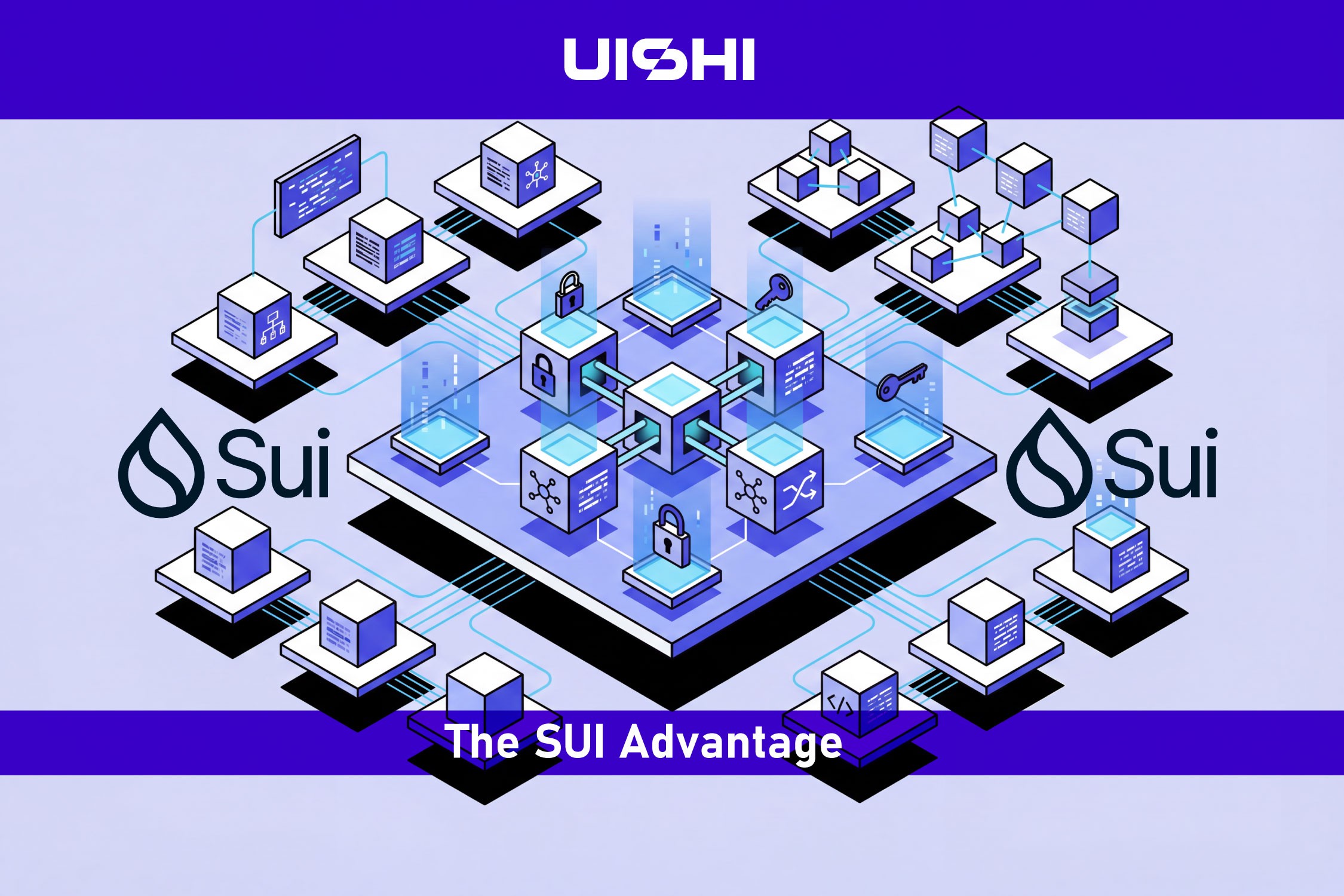
The SUI Advantage
The Importance of Platform Selection
One of the most consequential decisions in building a decentralized application is the choice of blockchain platform. The platform determines what is technically possible, what performance can be achieved, what security guarantees are provided, and what ecosystem of tools and services can be leveraged. Platform decisions are difficult to reverse; once significant development has occurred on a particular chain, migration to another platform is expensive and disruptive. The stakes are high, and the choice matters enormously.
For Uishi, the choice of platform was not made casually or based on superficial considerations. The founding team evaluated every major blockchain ecosystem, analyzing technical capabilities, performance characteristics, security properties, ecosystem maturity, and long-term viability. The goal was not simply to find a suitable platform but to find a platform that would enable capabilities impossible elsewhere. After extensive evaluation, the choice was clear: Uishi would be built on SUI Network, a blockchain that offers a fundamentally different approach to transaction processing and asset management.
This article explains why SUI was chosen and why SUI’s unique characteristics make it the ideal platform for Uishi’s vision of AI-powered, community-owned wealth creation. The analysis is technical but accessible, providing sufficient detail for readers to understand the architectural differences between SUI and other blockchains without requiring deep expertise in distributed systems. The goal is to convey not just what SUI does differently but why those differences matter for a project like Uishi.
Object-Centric Architecture
Most blockchains, including Ethereum and Solana, use an account-based model to represent the state of the system. In this model, each address has a balance, and transactions modify those balances. The system maintains a global state that records the current balance of every address, and transactions modify this global state in predetermined ways. This model is familiar and intuitive, drawing on the mental model of bank accounts that most people understand intuitively.
SUI takes a fundamentally different approach through its object-centric architecture. Rather than representing everything as balances in accounts, SUI represents assets as discrete objects. Each object has unique properties, can be modified independently, and can be transferred without affecting other objects in the system. This distinction might seem merely technical, but it has profound implications for what is possible on the platform.
The key advantage is parallel execution. In an account-based system, transactions that modify different accounts can technically be processed in parallel, but the system must maintain a global order to handle cases where transactions might affect the same accounts. This global ordering creates bottlenecks that limit throughput and introduce latency. In SUI’s object model, objects that are unrelated can be modified in parallel without any coordination, because there is no shared state that could create conflicts. The result is dramatically higher throughput and lower latency for applications that can be structured around independent objects.
For Uishi, this parallel execution capability is transformative. Treasury management involves managing hundreds of positions across dozens of strategies. On an account-based chain, rebalancing this portfolio would require processing transactions sequentially, creating delays and accumulating fees. On SUI, these same operations can execute in parallel, limited only by actual resource dependencies rather than artificial global ordering. The result is faster execution, lower costs, and the ability to implement strategies that would be economically impractical on other chains.
Sub-Second Finality
In blockchain systems, finality refers to the point at which a transaction becomes irreversible. Different blockchains have different finality characteristics: Bitcoin’s probabilistic finality can take an hour or more for high confidence, while some proof-of-stake chains offer faster confirmation. SUI achieves sub-second finality for most transactions, meaning that transactions are confirmed and irreversible within approximately four hundred milliseconds.
This speed is not a marginal improvement; it is a categorical change in what is possible for financial applications. In traditional finance and in slower blockchain systems, there is always a window between transaction submission and final confirmation during which the outcome remains uncertain. This uncertainty creates risk and limits the strategies that can be safely employed. With sub-second finality, that window essentially disappears, enabling strategies that would be too risky on slower chains.
For Uishi’s AI-powered treasury management, sub-second finality is essential. The AI agents that optimize the treasury must be able to execute transactions quickly enough to capture fleeting opportunities and respond rapidly to changing market conditions. A four-hundred-millisecond confirmation time means that when the AI decides to execute a trade, the trade is done almost instantly. There is no waiting for confirmation, no reorg risk to manage, no opportunity for slippage during the confirmation window. This speed advantage, maintained consistently across all market conditions, translates directly into superior execution and better returns for the treasury.
The Move Programming Language
SUI uses the Move programming language for smart contracts, a language designed specifically for digital asset management. Move was created with security as a primary concern, incorporating features that prevent common vulnerabilities that have plagued other smart contract platforms. The most significant of these features is the resource model, which ensures that digital assets cannot be accidentally duplicated or destroyed.
In most programming languages and in most smart contract systems, variables can be copied freely. If you have a number representing a token balance, you can make a copy of that number without restriction. This flexibility is useful for general-purpose programming but dangerous for financial applications where duplication would represent a catastrophic security failure. Move’s resource model treats digital assets as resources that can be transferred but never copied, with the type system enforcing this constraint at compile time. It is mathematically impossible to write a Move program that duplicates a resource; the compiler simply will not allow it.
For Uishi, this security foundation is invaluable. The smart contracts that manage the treasury, control membership, and implement governance will be handling significant value. Move’s type system provides inherent protection against entire categories of vulnerabilities that have cost DeFi users billions of dollars on other platforms. This is not a matter of careful programming or extensive auditing to avoid errors; it is a mathematical guarantee enforced by the language itself. Security is built into the foundation rather than being a property that must be achieved through effort and vigilance.
The Growing SUI Ecosystem
Beyond technical capabilities, SUI has developed a thriving ecosystem that provides essential infrastructure for applications like Uishi. The network has attracted over twenty-six billion dollars in total value locked, with established protocols across all major DeFi categories including lending, trading, and stablecoins. This ecosystem means that Uishi can leverage existing infrastructure rather than building everything from scratch, focusing development effort on the unique value it provides rather than recreating commodity functionality.
The ecosystem also includes a growing community of developers, users, and validators who contribute to the network’s vitality. This community provides a potential audience for Uishi’s services, a source of talent for team expansion, and partners for collaboration. The SUI Foundation has actively supported ecosystem development, including through partnerships with major technology companies that validate SUI’s technical capabilities and strategic positioning.
Perhaps most significantly, SUI has established a partnership with Google Cloud that has enabled the Agentic Payments Protocol, infrastructure specifically designed for AI agents to execute financial transactions. This partnership validates SUI as a serious platform for enterprise and institutional applications while providing infrastructure that Uishi’s AI treasury management will leverage. The combination of technical excellence, ecosystem maturity, and institutional validation makes SUI the clear choice for Uishi’s development.
Why SUI, Why Now
The convergence of SUI’s unique capabilities with Uishi’s vision creates an opportunity that could not have existed on other platforms. The object model enables parallel treasury operations that would be impossible on account-based chains. Sub-second finality enables the speed of execution that AI-powered treasury management requires. The Move language provides security guarantees that protect member assets. The growing ecosystem provides infrastructure and community that accelerate development.
This is not merely about building on a good platform; it is about building on the only platform that enables the specific capabilities that Uishi requires. The technical advantages of SUI translate directly into competitive advantages for Uishi. Better throughput means more sophisticated treasury management. Faster finality means better execution. Stronger security means lower risk. The choice of platform was not close; SUI was the only logical choice for a project with Uishi’s ambitions.
Uishi is SUI-native not for marketing purposes or to chase ecosystem grants. Uishi is SUI-native because SUI is where the vision becomes possible. The platform enables what would otherwise be impossible, and that capability is the foundation on which Uishi’s value proposition rests.
The Importance of Platform Selection
One of the most consequential decisions in building a decentralized application is the choice of blockchain platform. The platform determines what is technically possible, what performance can be achieved, what security guarantees are provided, and what ecosystem of tools and services can be leveraged. Platform decisions are difficult to reverse; once significant development has occurred on a particular chain, migration to another platform is expensive and disruptive. The stakes are high, and the choice matters enormously.
For Uishi, the choice of platform was not made casually or based on superficial considerations. The founding team evaluated every major blockchain ecosystem, analyzing technical capabilities, performance characteristics, security properties, ecosystem maturity, and long-term viability. The goal was not simply to find a suitable platform but to find a platform that would enable capabilities impossible elsewhere. After extensive evaluation, the choice was clear: Uishi would be built on SUI Network, a blockchain that offers a fundamentally different approach to transaction processing and asset management.
This article explains why SUI was chosen and why SUI’s unique characteristics make it the ideal platform for Uishi’s vision of AI-powered, community-owned wealth creation. The analysis is technical but accessible, providing sufficient detail for readers to understand the architectural differences between SUI and other blockchains without requiring deep expertise in distributed systems. The goal is to convey not just what SUI does differently but why those differences matter for a project like Uishi.
Object-Centric Architecture
Most blockchains, including Ethereum and Solana, use an account-based model to represent the state of the system. In this model, each address has a balance, and transactions modify those balances. The system maintains a global state that records the current balance of every address, and transactions modify this global state in predetermined ways. This model is familiar and intuitive, drawing on the mental model of bank accounts that most people understand intuitively.
SUI takes a fundamentally different approach through its object-centric architecture. Rather than representing everything as balances in accounts, SUI represents assets as discrete objects. Each object has unique properties, can be modified independently, and can be transferred without affecting other objects in the system. This distinction might seem merely technical, but it has profound implications for what is possible on the platform.
The key advantage is parallel execution. In an account-based system, transactions that modify different accounts can technically be processed in parallel, but the system must maintain a global order to handle cases where transactions might affect the same accounts. This global ordering creates bottlenecks that limit throughput and introduce latency. In SUI’s object model, objects that are unrelated can be modified in parallel without any coordination, because there is no shared state that could create conflicts. The result is dramatically higher throughput and lower latency for applications that can be structured around independent objects.
For Uishi, this parallel execution capability is transformative. Treasury management involves managing hundreds of positions across dozens of strategies. On an account-based chain, rebalancing this portfolio would require processing transactions sequentially, creating delays and accumulating fees. On SUI, these same operations can execute in parallel, limited only by actual resource dependencies rather than artificial global ordering. The result is faster execution, lower costs, and the ability to implement strategies that would be economically impractical on other chains.
Sub-Second Finality
In blockchain systems, finality refers to the point at which a transaction becomes irreversible. Different blockchains have different finality characteristics: Bitcoin’s probabilistic finality can take an hour or more for high confidence, while some proof-of-stake chains offer faster confirmation. SUI achieves sub-second finality for most transactions, meaning that transactions are confirmed and irreversible within approximately four hundred milliseconds.
This speed is not a marginal improvement; it is a categorical change in what is possible for financial applications. In traditional finance and in slower blockchain systems, there is always a window between transaction submission and final confirmation during which the outcome remains uncertain. This uncertainty creates risk and limits the strategies that can be safely employed. With sub-second finality, that window essentially disappears, enabling strategies that would be too risky on slower chains.
For Uishi’s AI-powered treasury management, sub-second finality is essential. The AI agents that optimize the treasury must be able to execute transactions quickly enough to capture fleeting opportunities and respond rapidly to changing market conditions. A four-hundred-millisecond confirmation time means that when the AI decides to execute a trade, the trade is done almost instantly. There is no waiting for confirmation, no reorg risk to manage, no opportunity for slippage during the confirmation window. This speed advantage, maintained consistently across all market conditions, translates directly into superior execution and better returns for the treasury.
The Move Programming Language
SUI uses the Move programming language for smart contracts, a language designed specifically for digital asset management. Move was created with security as a primary concern, incorporating features that prevent common vulnerabilities that have plagued other smart contract platforms. The most significant of these features is the resource model, which ensures that digital assets cannot be accidentally duplicated or destroyed.
In most programming languages and in most smart contract systems, variables can be copied freely. If you have a number representing a token balance, you can make a copy of that number without restriction. This flexibility is useful for general-purpose programming but dangerous for financial applications where duplication would represent a catastrophic security failure. Move’s resource model treats digital assets as resources that can be transferred but never copied, with the type system enforcing this constraint at compile time. It is mathematically impossible to write a Move program that duplicates a resource; the compiler simply will not allow it.
For Uishi, this security foundation is invaluable. The smart contracts that manage the treasury, control membership, and implement governance will be handling significant value. Move’s type system provides inherent protection against entire categories of vulnerabilities that have cost DeFi users billions of dollars on other platforms. This is not a matter of careful programming or extensive auditing to avoid errors; it is a mathematical guarantee enforced by the language itself. Security is built into the foundation rather than being a property that must be achieved through effort and vigilance.
The Growing SUI Ecosystem
Beyond technical capabilities, SUI has developed a thriving ecosystem that provides essential infrastructure for applications like Uishi. The network has attracted over twenty-six billion dollars in total value locked, with established protocols across all major DeFi categories including lending, trading, and stablecoins. This ecosystem means that Uishi can leverage existing infrastructure rather than building everything from scratch, focusing development effort on the unique value it provides rather than recreating commodity functionality.
The ecosystem also includes a growing community of developers, users, and validators who contribute to the network’s vitality. This community provides a potential audience for Uishi’s services, a source of talent for team expansion, and partners for collaboration. The SUI Foundation has actively supported ecosystem development, including through partnerships with major technology companies that validate SUI’s technical capabilities and strategic positioning.
Perhaps most significantly, SUI has established a partnership with Google Cloud that has enabled the Agentic Payments Protocol, infrastructure specifically designed for AI agents to execute financial transactions. This partnership validates SUI as a serious platform for enterprise and institutional applications while providing infrastructure that Uishi’s AI treasury management will leverage. The combination of technical excellence, ecosystem maturity, and institutional validation makes SUI the clear choice for Uishi’s development.
Why SUI, Why Now
The convergence of SUI’s unique capabilities with Uishi’s vision creates an opportunity that could not have existed on other platforms. The object model enables parallel treasury operations that would be impossible on account-based chains. Sub-second finality enables the speed of execution that AI-powered treasury management requires. The Move language provides security guarantees that protect member assets. The growing ecosystem provides infrastructure and community that accelerate development.
This is not merely about building on a good platform; it is about building on the only platform that enables the specific capabilities that Uishi requires. The technical advantages of SUI translate directly into competitive advantages for Uishi. Better throughput means more sophisticated treasury management. Faster finality means better execution. Stronger security means lower risk. The choice of platform was not close; SUI was the only logical choice for a project with Uishi’s ambitions.
Uishi is SUI-native not for marketing purposes or to chase ecosystem grants. Uishi is SUI-native because SUI is where the vision becomes possible. The platform enables what would otherwise be impossible, and that capability is the foundation on which Uishi’s value proposition rests.